Tactile Genesis

Exploring Tactile Sensors at Scale for Learning Dexterous Tasks

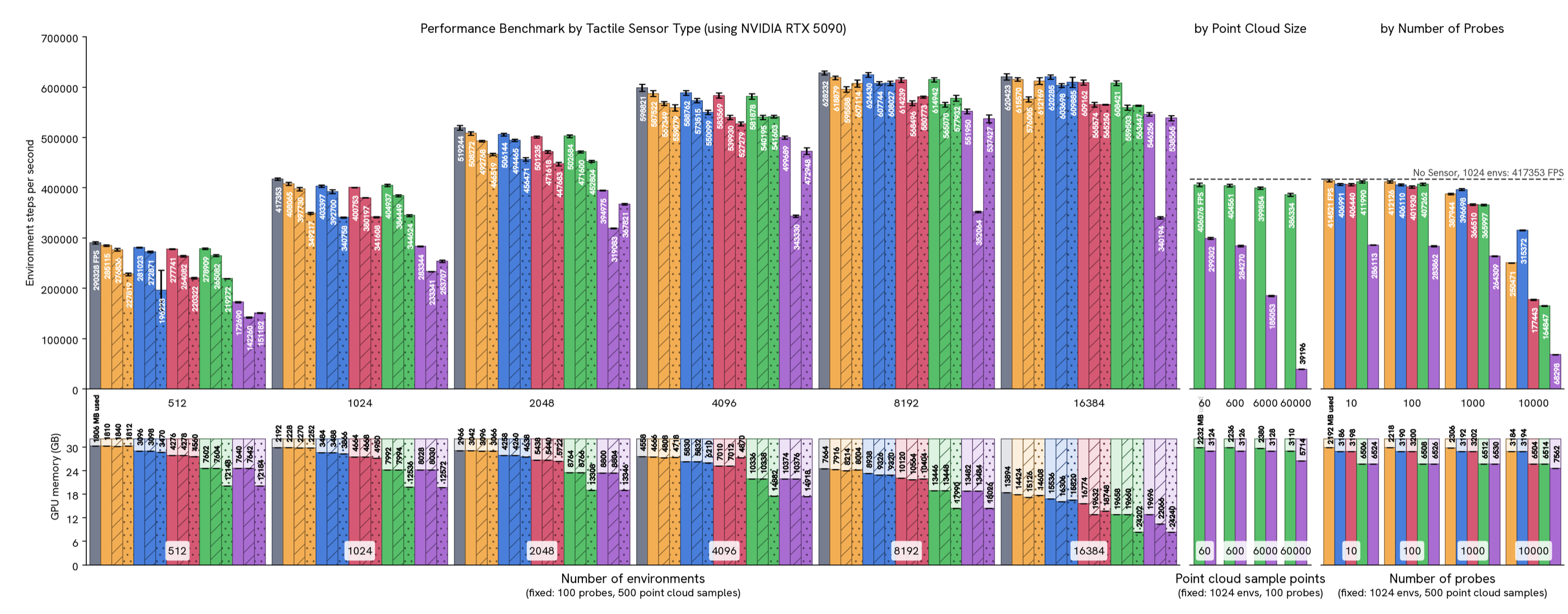
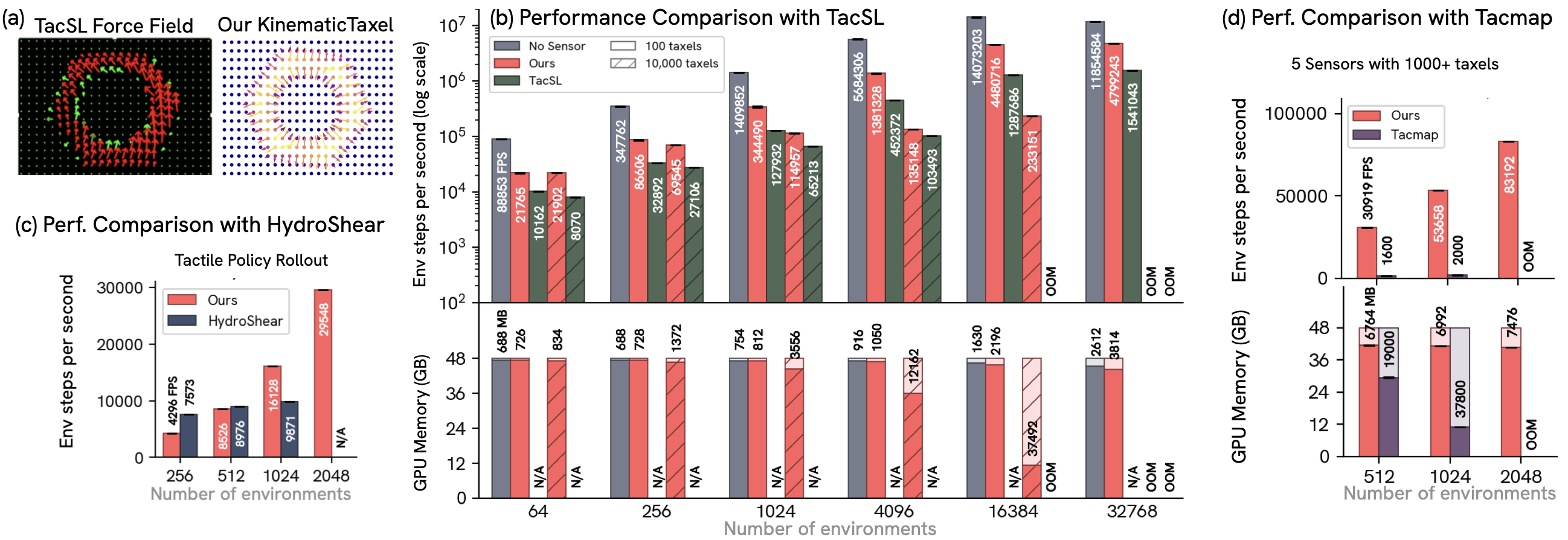
We integrate tactile sensors in Genesis physics simulation, exposing a representative set of tactile sensing abstractions — binary contact, contact depth, per-taxel force/torque, elastomer marker displacement, geometry-aware proximity, and a voxelized temperature field — under a common, configurable interface that runs across thousands of parallel environments on a single GPU.

Platform Overview

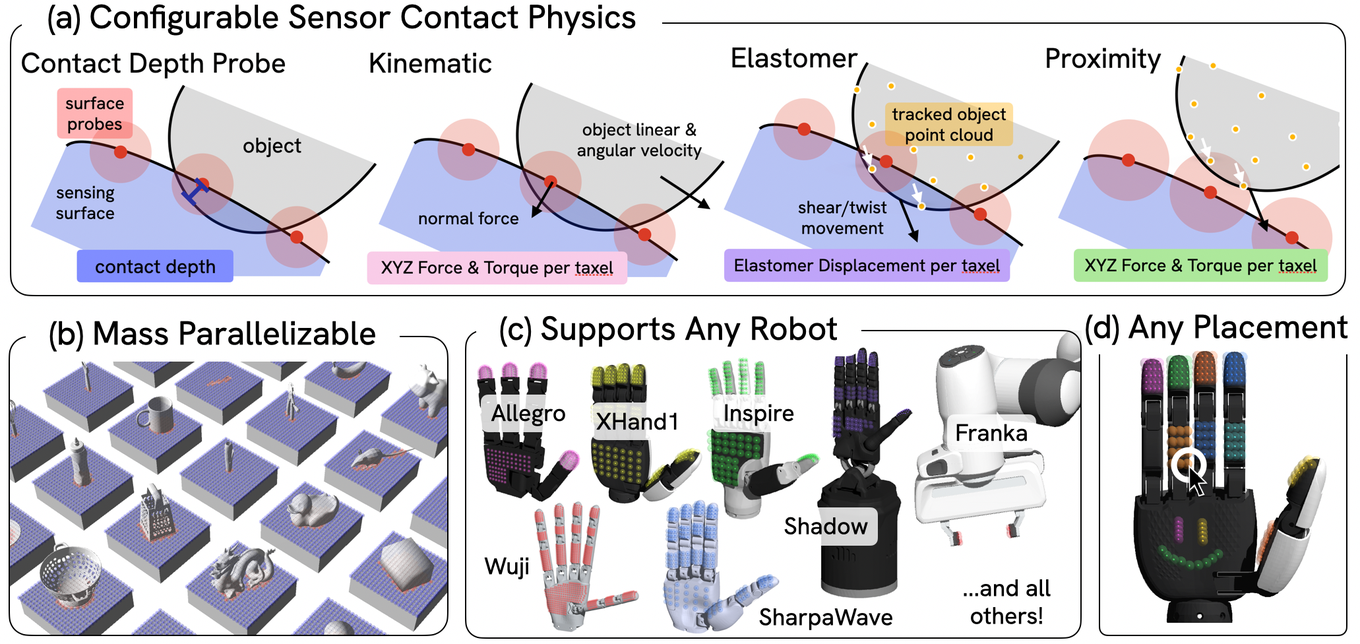
Overview of Tactile Genesis features
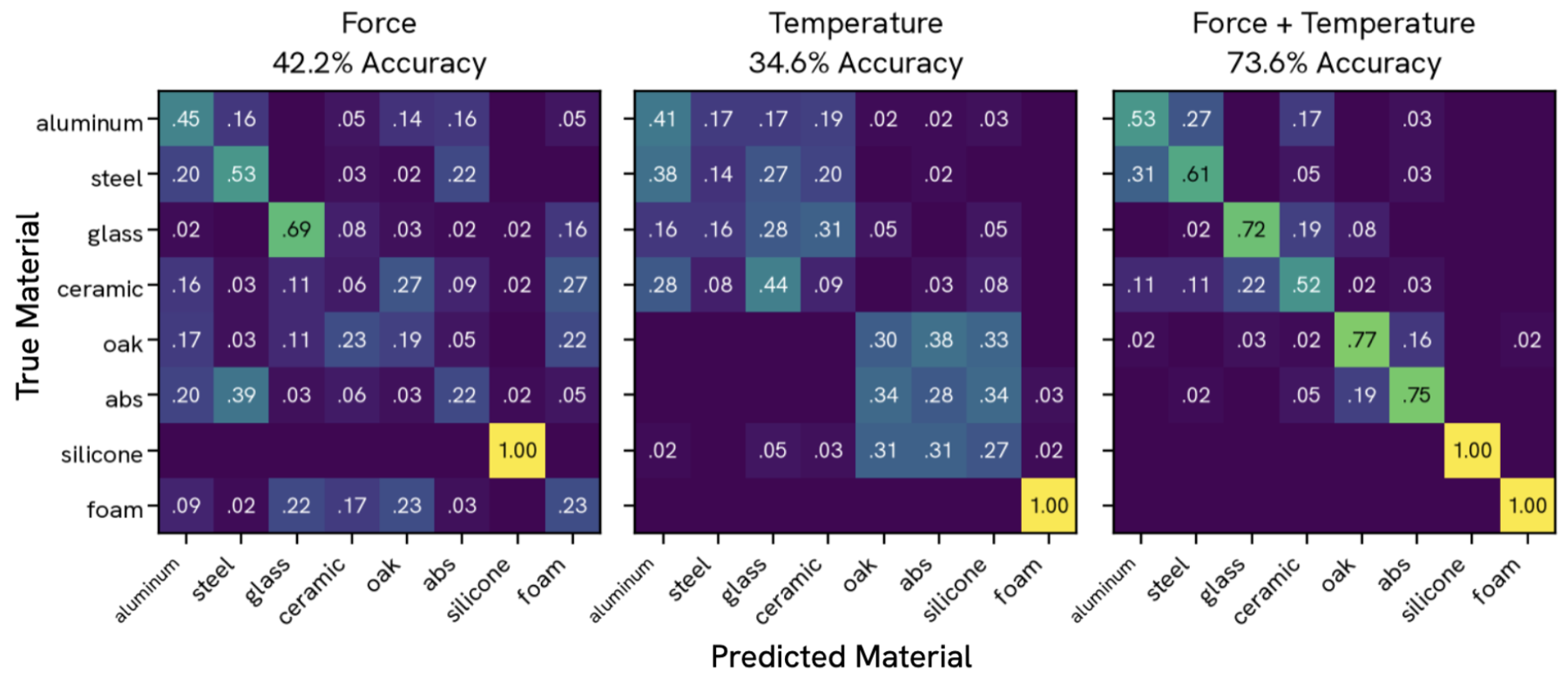
Overview of Tactile Genesis features. (a) Sensor physics configurable to match real analogues, including 6-axis force/torque, elastomer displacement, and proximity signals. (b) Simulated per-taxel tactile force on an XHand1 compared to the real XHand1. (c) Highly parallelized with heterogeneous objects and randomization. (d) Sensors apply to any robot surface, and (e) placement can be of arbitrary shape and resolution. (f) A temperature sensor simulating contact heat transfer, diffusion, generation, and radiation, plus a contact-audio sensor that the rigid-body engine alone cannot capture.

Real GelSight / Elastomer Comparison

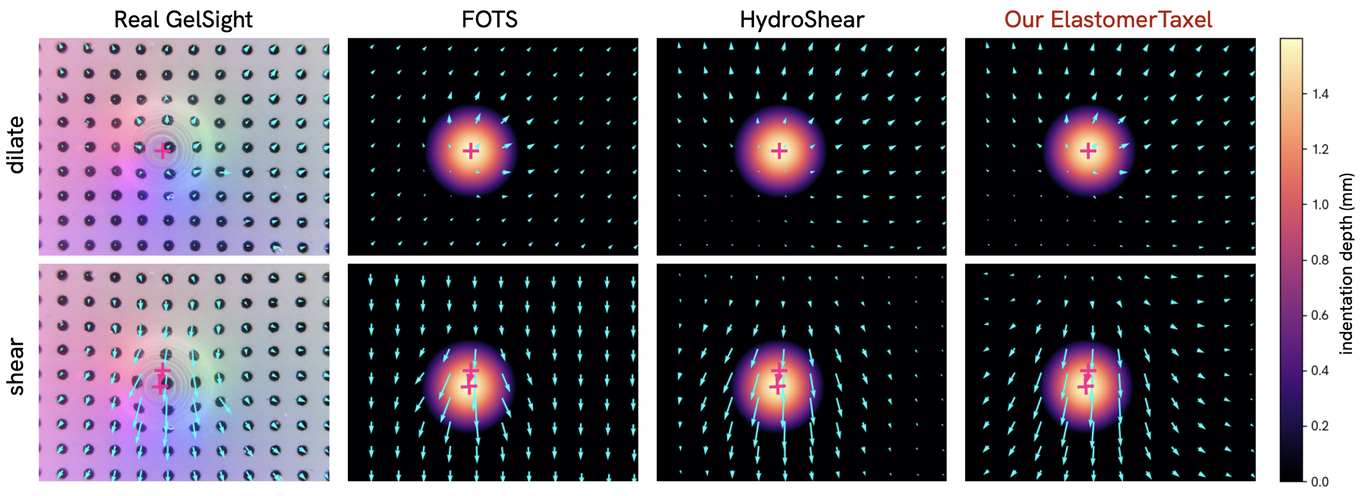
Real GelSight marker motion compared with simulated elastomer sensors
Elastomer marker motion comparison. Marker displacement fields on a real GelSight under dilation (normal indentation) and shear (tangential drag), compared with FOTS, HydroShear, and our ElastomerTaxel. The right-side table reports relative marker-displacement error after optimizing each simulator's parameters to match the real image.

Tactile Student Ablations

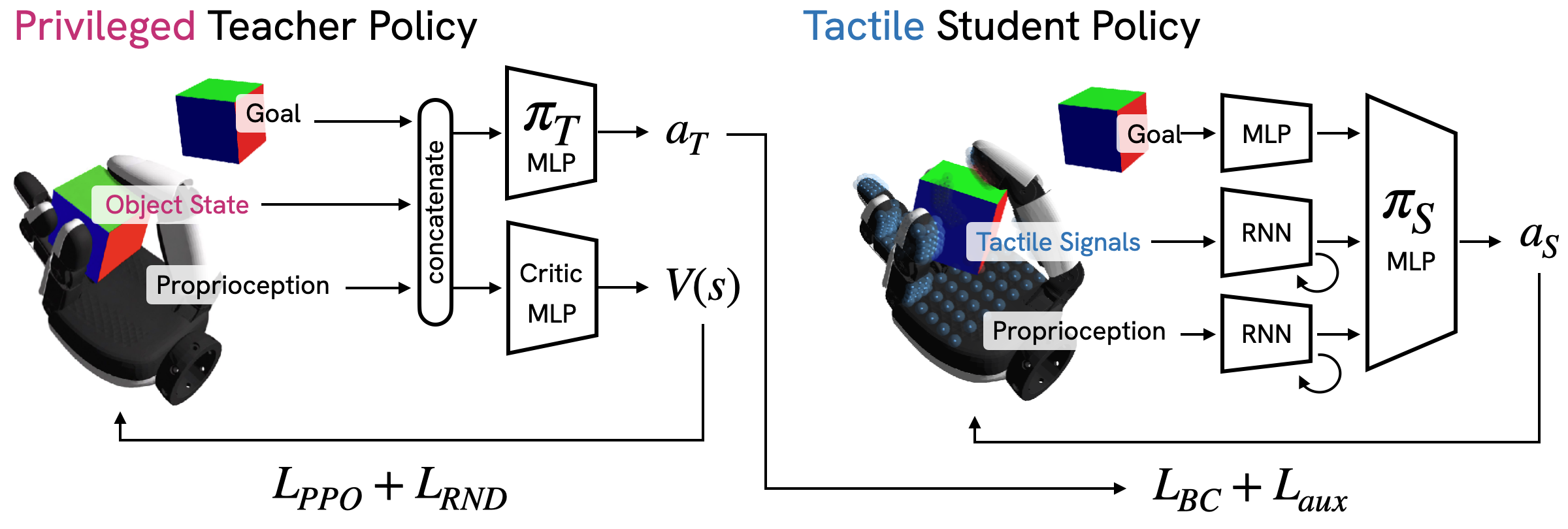
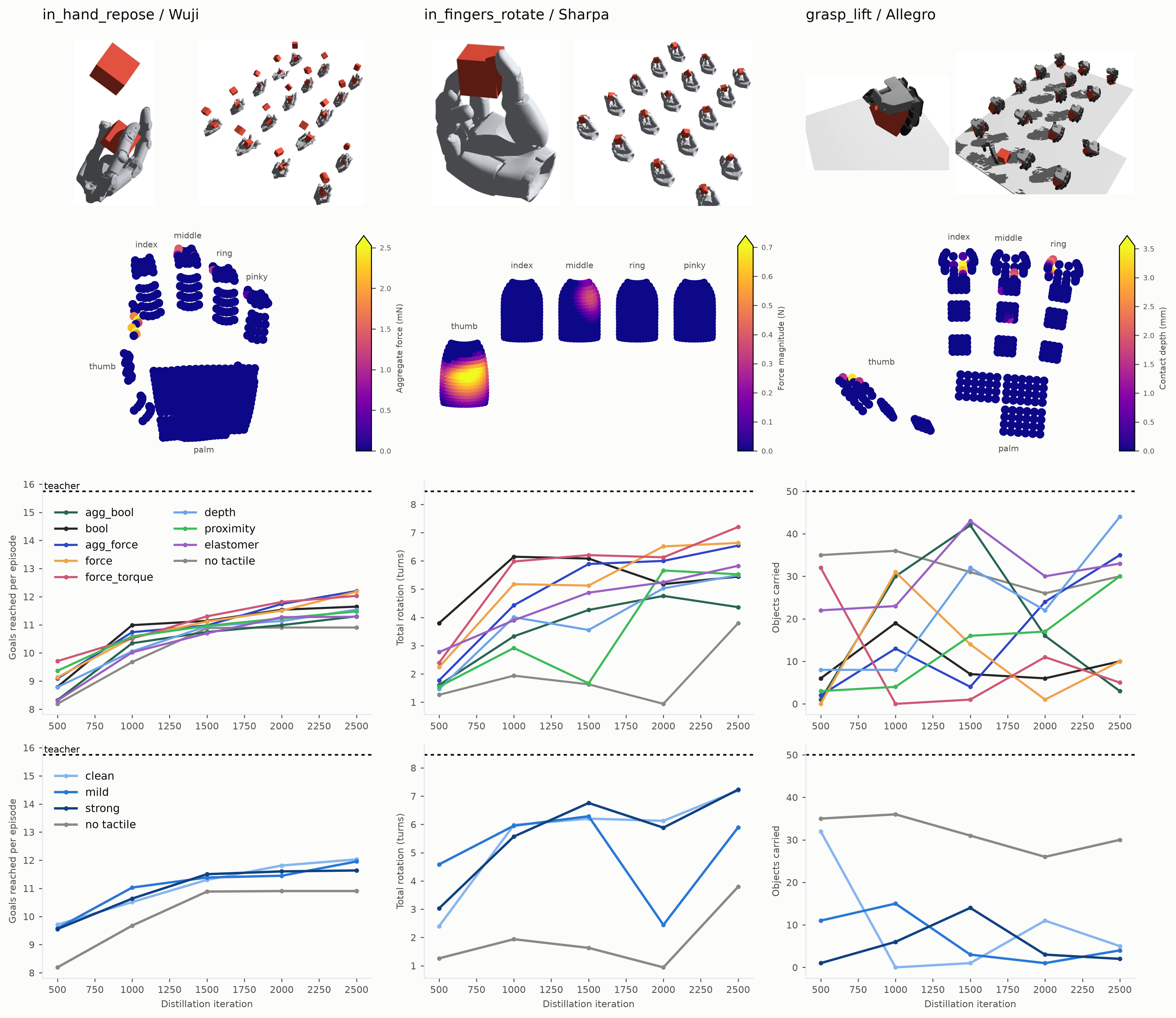
Tactile student ablations across three tasks
Tactile student ablations. Across in_palm_rotate, in_hand_repose, and screwdriver on the XHand1, we compare tactile data types against the privileged teacher and distilled tactile student, varying placement (tips / fingers / whole hand), resolution, and noise.

Key Findings

01

Proprioception is not enough

The proprioception-only baseline trails every tactile student on all three tasks. Touch is required to recover task-relevant object state.

02

Placement > sensor type

Fingertip-only sensing (what most commercial hardware supports) trails whole-hand coverage by a wide margin. Sensorizing palm and proximal phalanges matters more than upgrading the fingertip sensor.

03

Force/torque is a robust default

Aggregated across tasks, per-taxel force/torque matches or outperforms every other tactile representation.

04

Coverage > resolution

Resolution matters far less than coverage. Roughly 200 taxels spread across the whole hand suffice across all tasks studied.

Comparison figure for tactile sensing results

Contact Audio Demonstration

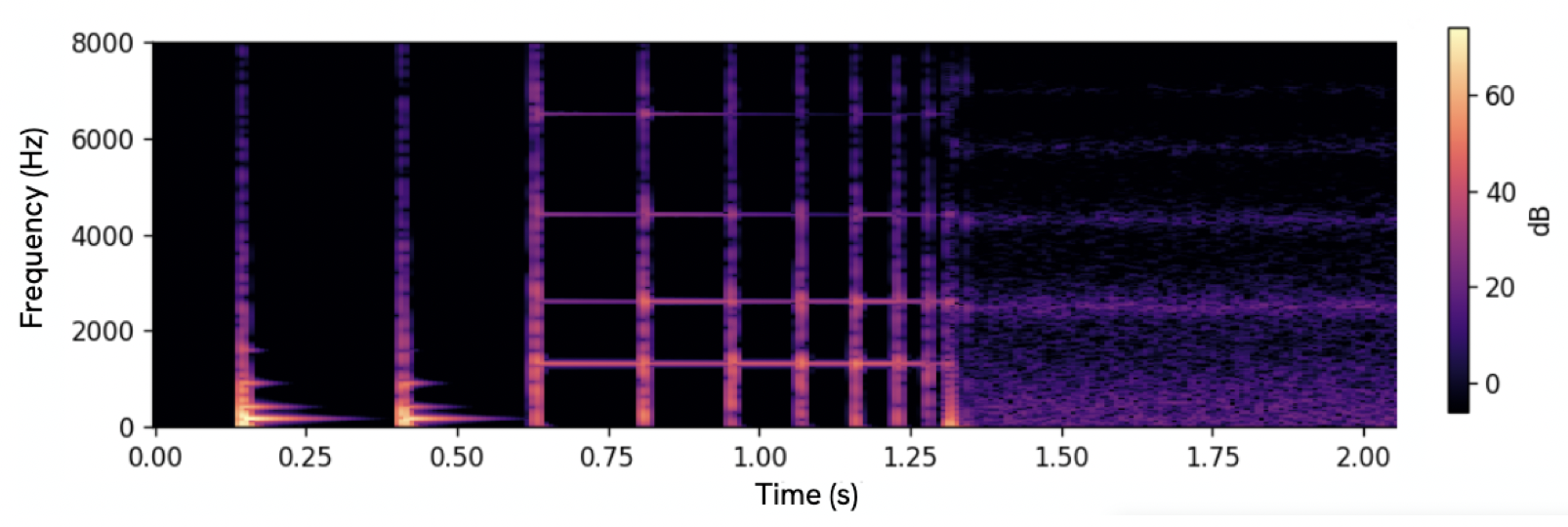
Spectrogram of simulated contact audio across materials
Contact audio sensor output. As the ball bounces and rolls along the different materials (wood, metal, glass), the contact audio sensor synthesizes sound based on contact physics and the material properties, which the rigid-body engine alone cannot capture.

BibTeX

@inproceedings{chung2026tactilegenesis,
  title     = {Tactile Genesis: Exploring Tactile Sensors at Scale
               for Learning Dexterous Tasks},
  author    = {Chung, Trinity and Yamazaki, Kashu and Patel, Dhruv and
               Duburcq, Alexis and Qiao, Yiling and
               Fragkiadaki, Katerina and Nayebi, Aran},
  booktitle = {Conference on Robot Learning (CoRL)},
  year      = {2026}
}